click to go to link
GOOD TO GREAT
THE FIVE DYSFUNCTIONS OF A TEAM
Patrick Lencioni
Members of teams with
an absence of trust. . .
- Conceal
their weaknesses and mistakes from one another
- Hesitate
to ask for help or provide constructive feedback
- Hesitate
to offer help outside their own areas of responsibility
- Jump
to conclusions about the intentions and aptitudes of others without
attempting to clarify them
- Fail
to recognize and tap into one another’s skills and experiences
- Waste
time and energy managing their behaviors for effect
- Hold
grudges
- Dread
meetings and find reasons to avoid spending time together
Members of trusting
teams. . .
- Admit
weaknesses and mistakes
- Ask
for help
- Accept
questions and input about their areas of responsibility
- Give
one another the benefit of the doubt before arriving at a negative
conclusion
- Take
risks in offering feedback and assistance
- Appreciate
and tap into one another’s skills and experiences
- Focus
time and energy on important issues, not politics
- Offer
and accept apologies without hesitation
- Look
forward to meetings and other opportunities to work as a group
Teams that fear
conflict. . .
- Have
boring meetings
- Create
environments where back-channel politics and personal attacks thrive
- Ignore
controversial topics that are critical to team success
- Fail
to tap into all the opinions and perspectives of team members
- Waste
time and energy with posturing and interpersonal risk management
Teams that engage in
conflict. . .
- Have
lively, interesting meetings
- Extract
and exploit the ideas of all team members
- Solve
real problems quickly
- Minimize
politics
- Put
critical topics on the table for discussion
Teams that engage in
conflict. . .
- Have
lively, interesting meetings
- Extract
and exploit the ideas of all team members
- Solve
real problems quickly
- Minimize
politics
- Put
critical topics on the table for discussion
A team that fails to
commit. . .
- Creates ambiguity among the team about direction and priorities
- Watches windows of opportunity close due to excessive analysis and unnecessary delay
- Breeds lack of confidence and fear of failure
- Revisits discussion and decisions again and again
- Encourages second-guessing among team members
A team that commits.
. .
- Creates
clarity around direction and priorities
- Aligns
the entire team around common objectives
- Develops
an ability to learn from mistakes
- Takes
advantage of opportunities before competitors do
- Moves
forward without hesitation
- Changes
direction with hesitation or guilt
A team that avoids
accountability. . .
- Creates resentment among team members who have different standards of performance
- Encourages mediocrity
- Misses deadlines and key deliverables
- Places an undue burden on the team leader as the sole source of discipline
A team that holds one
another accountable. . .
- Ensures that poor performers feel pressure to improve
- Identifies potential problems quickly by questioning one another’s approaches without hesitation
- Establishes respect among team members who are held to the same high standards
- Avoids excessive bureaucracy around performance management and corrective action
A team that is not
focused on results. . .
- Stagnates/fails to grow
- Rarely defeats competitors
- Loses achievement-oriented employees
- Encourages team members to focus on their own careers and individual goals
- Is easily distracted
A team that focuses
on collective results. . .
- Retains achievement-oriented employees
- Minimizes individualistic behavior
- Enjoys success and suffers failure acutely
- Benefits from individuals who subjugate their own goals/interests for the good of the team
- Avoids distractions
Erwin Raphael McManus
· “The purpose of the church cannot be to survive or even to thrive but to serve. And sometimes servants die in the serving.”
· “We are in grave danger when we have the most people and the most money in our history.”
· “The cultural environment became comfortable, and the gospel shifted from a church “on mission” to a church that supported missions.”
· “If those who prepare for leadership are looking for the safe place, who will lead the church into the dangerous places?”
· “You can change the name, but if you don’t change the heart, the atrophy will kill you in the end.”
· “Our resolution to be discomforted with technology will ensure that we remain at least fifty years behind.”
· We live in a world defined by speed. We get there faster, get it faster, and want it faster.”
· “Too often, the church becomes our secure place, our haven from the outside world.”
· “The key to dealing with this rapidly changing world, to dealing with this culture addicted to speed, is not to catch up but to give up on keeping up.”
· “The way not to be overwhelmed by the radical changes and speed in our world is to know where you’re going, to know why you’re going there, and to do it with urgency.”
· “Although change is rarely taught or extracted from the Scriptures, the Scriptures are a document about change.”
· “God calls us to take the memories with us but to leave the memorabilia behind.”
· “Simply stated, if the Bible doesn’t bring change, it is not being engaged.”
· “We are not only called to be changed and to embrace change but to be the catalysts of change.”
· “The further we are from the past, the better we remember it – but not the clearer. Soon the details are lost to the dream. In the end what we remember never existed.”
· “When our children grow up, they mirror what we’ve really cared about.”
· “The problem in many of our congregations is not that we’ve chosen a wrong strategy or have an irrelevant style but that we have an unhealthy culture.”
· “When you alter the methods of a church, you are, in effect trampling memories.”
· “True leaders are able to influence not only individuals, but also environments.”
· “People know what you care about by what you’re willing to die for.”
Jim Collins
CHAPTER 1 GOOD
IS THE ENEMY OF GREAT
Good is the enemy of great. And that is one of the key reasons why we have so little that becomes great.
We don’t have great schools, principally because we have good schools. We don’t have great government, principally because we have good government. Few people attain great lives, in large part because it is just too easy to settle for a good life. The vast majority of companies never become great, precisely because the vast majority become quite good – and that is their main problem.
Can a good company become a great company and, if so how? Or is the disease of “just being good” incurable?
A research team embarked on a five year research effort, a journey to explore the inner workings of a good to great.
They identified companies that made the leap from good results to great results and sustained those results for at least 15 years. They compared the companies to a carefully selected control group of comparison companies that failed to make the leap, or if they did, failed to sustain it. Then they compared the good-to-great companies to the comparison companies to discover the essential and distinguishing factors at work.
The good-to-great examples that made the final cut into the study attained extraordinary results, averaging cumulative stock returns 6.9 times the general market in 15 years following their transition points.
One case Walgreens. For over 40 years, Walgreens had bumped along as a very average company, more or less tracking the general market. Then in 1975, seemingly out of nowhere – bang! – Walgreens began to climb … and climb … and climb…and climb … and it just kept climbing. From December 31, 1975, to January 1, 2000, $1 invested in Walgreens beat $1 invested in technology superstar Intel by nearly two times, General Electric by nearly five times, Coca-Cola by nearly eight times, and the general stock market (including the NASDAQ stock run-up at the end of 1999) by over fifteen times.
How on earth did a company with such a long history of being nothing special transform itself into an enterprise that outperformed some of the best-led organizations in the world? Why was Walgreens able to make the leap when other companies like Eckerd, did not?
With that question we began to assemble a team of researchers to find companies that showed the good-to-great pattern. We looked for companies that showed the following basic pattern: fifteen year cumulative stock returns at or below the general stock market, punctuated by a transition point, then cumulative rturns at least three times the market over the next fifteen years. Fifteen years was picked because it would transcend one-hit wonders and lucky breaks and would exceed the average tenure of most chief executive officers. Three times the market was picked because it exceeds the performance of most widely acknowledged great companies. For perspective, a mutual fund of the following “marquis set” of companies beat the market by only 2.5 times over the years 1985 to 2000: 3M, Boeing, Coca-Cola, GE, Hewlett-Packard, Intel, Johnson & Johnson, Merck, Motorola, Pepsi, Procter & Gamble, Wal-Mart, and Walt Disney. Not a bad set to beat.
From the initial universe of companies that appeared on the Fortune 500 in the years 1965 to 1995, we systematically searched and sifted, eventually finding eleven good-to-great examples.
Company Transition
Point
Abbott 3.98 times the market 1974-1989
Circuit City 18.50 times the market 1982-1997
Fannie Mae 7.56 times the market 1984-1999
Gillette 7.39 times the market 1980-1995
Kimberly-Clark 3/42 times the market 1972-1987
Kroger 4.17 times the market 1973-1988
Nucor 5.16 times the market 1975-1990
Philip Morris 7.06 times the market 1964-1979
Pitney Bowes 7.16 times the market 1973-1988
Walgreens 7.34 times the market 1975-1990
Wells
Level
5 Leadership.
We were surprised, shocked really, to discover the type of leadership required for turning a good company into a great one. The good-to-great leaders seem to have come from Mars. Self-effacing, quiet, reserve, even shy—these leaders are a paradoxical blend of personal humility and profession will. They are more like Lincoln and Socrates than Patton or Caesar.
First Who.
. .Then What.
We expected the good-to-great leaders would begin by setting a new vision and strategy. Instead they first got the right people on the bus, the wrong people off the bus, and the right people in the right seats – and then they figured out where to drive it. The old adage “People are your most important asset” turns out to be wrong. People are ot your most important asset. The right people are.
Confront the Brutal Facts (Yet Never Lose Faith.)
You must maintain unwavering faith that you can and will prevail in the end, regardless of the difficulties, AND at the same time have the discipline to confront the most brutal facts of your current reality, whatever they might be.
The Hedgehog Concept (Simplicity within the Three Circles).
To go from good to great requires transcending the curse of competence. Just because something is your core business – just because you’ve been doing it for years or perhaps even decades – does not necessarily mean you can be the best in the world at it. If you cannot be the best in the world at your core business, then your core business absolutely cannot form the basis of a great company. It must be replaced with a simple concept that reflects deep understanding of three intersecting circles.
A
Culture of Discipline.
All companies have a culture, some companies have discipline, but few companies have a culture of discipline. When you combine a culture of discipline with an ethic of entrepreneurship, you get the magical alchemy of great performance.
Technology
Accelerators.
Good-to-great companies think differently about the role of technology. They never use technology as the primary means of igniting a transformation.
The
Flywheel and the Doom
Those who launch revolutions, dramatic change programs, and wrenching restructurings will almost certainly fail to make the leap from good to great. Good-to great transformations never happened in one fell swoop. Rather, the process resembled relentlessly pushing a giant heavy flywheel in one direction, turn upon turn, building momentum until a point of breakthrough, and beyond.
From
Good to Great to Built to Last.
Good to Great is about how to turn a good organization into one that produces sustained great results. Built to Last is about how you take a company with great results and turn it into an enduring great company of iconic stature.
The Timeless “Physics” of Good to Great
Question? Don’t we need to throw out all the old ideas and start from scratch? Yes, the world is changing, and will continue to do so. But that does not mean we should stop the search for timeless principles. Yes, the specific application will change, but certain immutable laws of organized human performance will endure.
There’s nothing new about being a new economy.
This book is about one thing: the timeless principles of good to great. It’s about how you take a good organization and turn it into one that produces sustained great results, using whatever definition of results best applies to your organization.
Good is the enemy of great is not just a business problem. It is a human problem.
CHAPTER 2 LEVEL 5 LEADERSHIP
Level 5 LEVEL 5 EXECUTIVE
Builds enduring greatness through a paradoxical blend of personal humility and professional will.
Level 4 EFFECTIVE LEADER
Catalyzes commitment to and vigorous pursuit of a clear and compelling vision, stimulating higher performance standards.
Level 3 COMPETENT MANAGER
Organizes people and resources toward the effective and efficient pursuit of predetermined objectives.
Level 2 CONTRIBUTING TEAM MEMBER
Contributes individual capabilities to the achievement of group objectives and works effectively with others in a group setting.
Level 1 HIGHLY CAPABLE INDIVIDUAL
Makes productive contributions through talent, knowledge, skills, and good work habits.
Level 5 leaders channel their ego needs away from themselves and into the larger goal of building a great company. The term Level 5 refers to the highest level in a hierarchy of executive capabilities that was identified in the research.
HUMILITY + WILL = LEVEL 5
Level 5 leaders are a study in duality: modest and willful, humble and fearless.
Ambition for the Company: Setting up Successors for Success
A key trait of Level 5 leaders is: ambition first and foremost for the company and concern for its success rather than for one’s own riches and personal renown. Level 5 leaders want to see the company even more successful in the next generation, comfortable with the idea that most people won’t even know that the roots of that success trace back to their efforts.
In contrast, the comparison leaders, concerned more with their own reputation for personal greatness, often failed to set the company up for success in the next generation. After all, what better testament to your own personal greatness than that the place falls apart after you leave?
Good to great leaders didn’t talk about themselves. They’d talk about the company and the contributions of other executives but would deflect discussion about their own contributions.
The good-to-great leaders never wanted to become larger-than-life heroes.
Level 5 leadership is not just about humility and modesty. It is equally about ferocious resolve, an almost stoic determination to do whatever needs to be done to make the company great. Level 5 leaders are fanatically driven, infected with an incurable need to produce results. They will sell the mills or fire their brother, if that’s what it takes to make the company great.
Ten out of eleven good-to-great CEOs came from inside the company, three of them by family inheritance.
Summary: The Two Sides of Level
5 Leadership
Professional Will Personal
Humility
|
Creates superb results, a clear catalyst in the transition from good to great. |
Demonstrates a compelling modesty, shunning public adulation; never boastful. |
|
Demonstrates an unwavering resolve to do whatever must be done to produce the best long term results, no matter how difficult. |
Acts with quiet, calm determination; relies principally on inspired standards, not inspiring charisma, to motivate. |
|
Sets the standard of building an enduring great company; will settle for nothing less. |
Channels ambition into the company, not the self; sets up successors for even greater success in the next generation. |
|
Looks in the mirror, not out the window, to apportion responsibility for poor results, never blaming other people, external factors, or bad luck. |
Looks out the window, not in the mirror, to apportion credit for the success of the company – to other people, external factors, and good luck. |
There are two categories of people: those who do not have the seed of Level 5 and those who do. The first category consists of people who could never in a million years bring themselves to subjugate their egoistic needs to the greater ambition of building something larger and more lasting than themselves. For these people, work will always be first and foremost about what they get – fame, fortune, adulation, power, whatever – not what they build, create, and contribute.
The great irony is that the animus and personal ambition that often drive people to positions of power stand at odds with the humility required for Level 5 leadership. When you combine that irony with the fact that boards of directors frequently operate under the false belief that they need to hire a larger-than-life, egocentric leader to make an organization great, you can quickly see why Level 5 leaders rarely appear at the top of our institutions.
The second category of people consists of those who have the potential to evolve to Level 5; the capability resides within them, perhaps buried or ignored, but there nonetheless. And under the right circumstances – self-reflection, conscious personal development, a mentor, a great teacher, loving parents, a significant life experience, a Level 5 boss, or any number of other factors they begin to develop.
Chapter Summary Key
Points
- Every good-to-great company had Level 5 leadership during the pivotal transition years.
- “Level 5” refers to a five-level hierarchy of executive capabilities, with Level 5 at the top. Level 5 leaders embody a paradoxical mix of personal humility and professional will. They are ambitious, to be sure, but ambitious first and foremost for the company, not themselves.
- Level 5 leaders set up their successors for even great success in the next generation, whereas egocentric Level 4 leaders often set up their successors for failure.
- Level 5 leaders display a compelling modesty, are self-effacing and understated. In contrast, two thirds of the comparison companies had leaders with gargantuan personal egos that contributed to the demise or continued mediocrity of the company.
- Level 5 leaders are fanatically driven, infected with an incurable need to produce sustaine results. They are resolved to do whatever it takes to make the company great, no matter how big or hard the decisions.
- Level 5 leaders display a workmanlike diligence – more plow horse than show horse.
- Level 5 leaders look out the window to attribute success to factors other than themselves. When things go poorly, however, they look in the mirror and blame themselves, taking full responsibility. The comparison CEOs often did just the opposite – they looked in the mirror to take credit for success, but out the window to assign blame for disappointing results.
- One of the most damaging trends in recent history is the tendency (especially by boards of directors) to select dazzling, celebrity leaders and to de-select potential Level 5 leaders.
- I believe that potential Level 5 leaders exist all around us, if we just know what to look for, and that many people have the potential to evolve into Level 5.
|
Level 5 + Management Team (Good-to-Great Companies) |
A “Genius with a Thousand Helpers” (Comparison Companies) |
|
Level 5 Leader ↓ |
Level 4 Leader ↓ |
|
First Who Get the right people on the bus. Build a superior executive team. |
First What Set a vision for where to drive the bus. Develop a road map for driving the bus. |
|
↓ Then What Once you have the right people in place, figure out the best path to greatness. |
↓ Then Who Enlist a crew of highly capable “helpers” to make the vision happen |
Three practical disciplines were extracted from the research for being rigorous rather than ruthless.
Practical Discipline #1: When in doubt, don’t hire – keep looking
Practical Discipline #2: When you know you need to make a people change, act.
Practical Discipline #3: Put your best people on your biggest opportunities, not your biggest problems.
Chapter Summary Key
Points
- The good-to-great leaders began the transformation by first getting the right people on the bus (and the wrong people off the bus) and then figured out where to drive it.
- The key point of this chapter is not just the idea of getting the right people on the team. The key point is that “who” questions come before “what” decisions – before vision, before strategy, before organization structure, before tactics. First who, then what – as a rigorous discipline, consistently applied.
- The comparison companies frequently followed the “genius with a thousand helpers” model – a genius leader who sets a vision and then enlists a crew of highly capable “helpers” to make the vision happen. This model fails when the genius departs.
- The good-to-great leaders were rigorous, not ruthless, in people decisions. They did not rely on layoffs and restructuring as a primary strategy for improving performance. The comparison companies used layoffs to a much greater extent.
- We uncovered three practical disciplines for being rigorous in people decisions:
1. When in doubt, don’t hire – keep looking. (Corollary: A company should limit its growth based on its ability to attract enough of the right people.
2. When you know you need to make a people change, act. (Corollary: First be sure you don’t simply have someone in the wrong seat.)
3. Put your best people on your biggest opportunities, not your biggest problems. (Corollary: If you sell off your problems, don’t sell off your best people.)
- Good-to-great management teams consist of people who debate vigorously in search of the best answers, yet who unify behind decisions, regardless of parochial interests.
- We found no systematic pattern linking executive compensation to the shift from good to great. The purpose of compensation is not to “motivate” the right behaviors from the wrong people, but to get and keep the right people in the first place.
- The old adage “People are your most important asset” is wrong. People are not your most important asset. The right people are.
- Whether someone is the “right person” has more to do with character traits and innate capabilities than with specific knowledge, background or skills.
CHAPTER
4 CONFRONT THE BRUTAL FACTS (Yet Never Lose Faith)
Chapter Summary Key
Points
- All good-to-great companies began the process of finding a path to greatness by confronting the brutal facts of their current reality.
- When you start with an honest and diligent effort to determine the truth of your situation, the right decisions often become self evident. It is impossible to make good decisions without infusing the entire process with an honest confrontation of the brutal facts.
- A primary task in taking a company from good to great is to create a culture wherein people have a tremendous opportunity to be heard and, ultimately, for the truth to be heard.
- Creating a climate where the truth is heard involves four basic practices:
1. Lead with questions, not answers.
2. Engage in dialogue and debate, not coercion.
3. Conduct autopsies, without blame.
4. Build red flag mechanisms that turn information into information that cannot be ignored.
- The good-to-great companies faced just as much adversity as the comparison companies, but responded to that adversity differently. They hit the realities of their situation head-on. As a result, they emerged from adversity even stronger.
- A key psychology for leading from good to great is the Stockdale Paradox: Retain absolute faith that you can and will prevail in the end, regardless of the difficulties, AND at the same time confront the most brutal facts of your current reality, whatever they might be.
- Charisma can be as much a liability as an asset, as the strength of your leadership personality can deter people from bringing you the brutal facts.
- Leadership does not begin just with vision. It begins with getting people to confront the brutal facts and to act on the implications.
- Spending time and energy trying to “motivate” people is a waste of effort. The real question is not, “How do we motivate our people?” If you have the right people, they will be self-motivated. The key is to not de-motivate them. One of the primary ways to de-motivate people is to ignore the brutal facts of reality.
CHAPTER 5 THE
HEDGEHOG CONCEPT (Simplicity within the Three Circles)
Chapter Summary Key
Points
·
To go from good to great requires a deep
understanding of the three intersecting circles translated into a simple,
crystalline concept (the Hedgehog Concept):
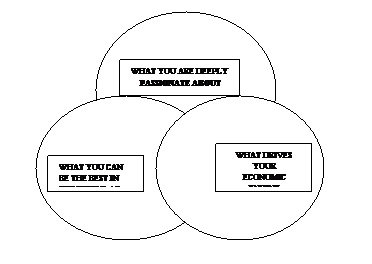
· The key is to understand what your organization can be the best in the world at, and equally important what it cannot be the best at not what it “wants” to be the best at. The Hedgehog Concept is not a goal, strategy, or intention; it is an understanding.
· If you cannot be the best in the world at your core business, then your core business cannot form the basis of your Hedgehog Concept.
· The “besting the world” understanding is a much more severe standard than a core competence. You might have a competence but not necessarily have the capacity to be truly the best in the world at that competence. Conversely, there may be activities at which you could become the best in the world, but at which you have no current competence.
· To get insight into the drivers of your economic engine, search for the one denominator (profit per x or, in the social sector, cash flow per x) that has the single greatest impact.
· Good-to-great companies set their goals and strategies based on understanding; comparison companies set their goals and strategies based on bravado.
· Getting the Hedgehog Concept is an iterative process. The Council can be a useful device.
Unexpected Findings
· The good-to-great companies are more like hedgehogs – simple, dowdy creatures that know “one big thing” and stick to it. The comparison companies are more like foxes – crafty, cunning creatures that know many things yet lack consistency.
· It took four years on average for the good-to-great companies to get a Hedgehog Concept.
· Strategy per se did not separate the good-to-great companies from the comparison companies. Both sets had strategies, and there is no evidence that the good-to-great companies spent more time on strategic planning than the comparison companies.
· You absolutely do not need to be in a great industry to produce sustained great results. No matter how bad the industry, every good-to-great company figured out how to produce truly superior economic returns.
CHAPTER 6 A CULTURE
OF DISCIPLINE
Chapter Summary Key
Points
· Sustained great results depend upon building a culture full of self-disciplined people who take disciplined action, fanatically consistent with the three circles.
· Bureaucratic cultures arise to compensate for incompetence and lack of discipline, which arise from having the wrong people on the bus in the first place. If you get the right people on the bus, and the wrong people off, you don’t need stultifying bureaucracy.
· A culture of discipline involves a duality. On the one hand, it requires people who adhere to a consistent system; yet, on the other hand, it gives people freedom and responsibility within the framework of that system.
· The good-to-great companies appear boring and pedestrian looking in from the outside, but upon closer inspection, they’re full of people who display extreme diligence and a stunning intensity (they “rinse their cottage cheese”).
· Do not confuse a culture of discipline with a tyrant who disciplines – they are very different concepts, one highly functional, the other highly dysfunctional. Savior CEOs who personally discipline through sheer force of personality usually fail to produce sustained results.
· The single most important form of discipline for sustained results is fanatical adherence to the Hedgehog Concept and the willingness to shun opportunities that fall outside the three circles.
UNEXPECTED FINDINGS
· The more an organization has the discipline to stay within its three circles, with almost religious consistency, the more it will have opportunities for growth.
· The fact that something is a “once-in-a-lifetime opportunity” is irrelevant, unless it fits within the three circles. A great company will have many once-in-a-lifetime opportunities.
· The purpose of budgeting in a good-to-great company is not to decide how much each activity gets, but to decide which arenas best fit with the Hedgehog Concept and should be fully funded and which should not be funded at all.
· “Stop doing” lists are more important than “to do” lists.
CHAPTER 7 TECHNOLOGY ACCELERATORS
·
Good-to-great organizations think differently
about technology and technological change than mediocre ones.
·
Good-to-great organizations avoid technology
fads and bandwagon, yet they become pioneers in the application of carefully
selected technologies.
·
The key question about any technology is, Does the technology fit directly with your Hedgehog
Concept? If yes, then you need to become
a pioneer in the application of that technology. If no, then you can settle for parity or
ignore it entirely.
·
The good-to-great companies used technology as
an accelerator of momentum, not a creator of it. None of the good-to-great companies began
their transformations with pioneering technology, yet they all became pioneers
in the application of technology once they grasped how it fit with their three
circles and after they hit breakthrough.
·
You could have taken the exact same leading-edge
technologies pioneered at the good-to-great companies and handed them to their direct
comparisons for free, and the comparisons still would have failed to produce
anywhere near the same results.
· How a company reacts to technological change is a good indicator of its inner drive for greatness versus mediocrity. Great companies respond with thoughtfulness and creativity, driven by a compulsion to turn unrealized potential into results; mediocre companies react and lurch about, motivated by fear of being left behind.
UNEXPECTED FINDINGS
·
The idea that technological change is the
principal cause in the decline of once-great companies (or the perpetual
mediocrity of others) is not supported by the evidence. Certainly, a company can’t remain a laggard
and hope to be great, but technology by itself is never a primary root cause of
either greatness or decline.
·
Across eighty-four interviews with good-to-great
executives, fully 80 percent didn’t even mention technology as one of the top
five factors in the transformation. This
is true even in companies famous for their pioneering application of
technology, such as Nucor.
·
“Crawl, walk, run” can be a very effective
approach, even during times of rapid and radical technological change.
CHAPTER 8 THE FLYWHEEL AND THE DOOM LOOP
·
Good-to-great transformations often look like
dramatic, revolutionary events to those observing from the outside, but they
feel like organic, cumulative processes to people on the inside. The confusion of end outcomes (dramatic
results) with process (organic and cumulative) skews our perception of what
really works over the long haul.
·
No matter how dramatic the end result, the
good-to-great transformations never happened in one fell swoop. There was no single defining action, no grand
program, no one killer innovation, no solitary lucky break, no
miracle moment.
·
Sustainable transformations follow a predictable
pattern of buildup and breakthrough.
Like pushing on a giant, heavy flywheel, it takes a lot of effort to et the thing moving at all, but with persistent pushing in a
consistent direction over a long period of time, the flywheel builds momentum,
eventually hitting a point of breakthrough.
·
The comparison companies followed a different
pattern, the doom loop. Rather than
accumulating momentum – turn by turn of the flywheel – they tried to skip
buildup and jump immediately to breakthrough.
Then, with disappointing results, they’d lurch back and forth, failing
to maintain a consistent direction.
·
The comparison companies frequently tried to
create a breakthrough with large, misguided acquisitions. The good-to-great companies, in contrast,
principally used large acquisitions after breakthrough, to accelerate momentum
in an already fast-spinning flywheel.
UNEXPECTED
RESULTS
· Those inside the good-to-great companies were often unaware of the magnitude of their transformation at the time; only later, in retrospect, did it become clear. They had no name, tag line, launch event, or program to signify what they were doing at the time.
· The good-to-great leaders spent essentially no energy trying to “create alignment,” motivate the troops,” or “manage change. “Under the right conditions, the problems of commitment, alignment, motivation, and change largely take care of themselves. Alignment principally follows from results and momentum, not the other way around.
· The short-term pressures of Wall Street were not inconsistent with the following this model. The flywheel effect is not in conflict with these pressures. Indeed, it is the key to managing them.
CHAPTER 9 FROM GOOD TO GREAT TO BUILT TO LAST
Early in research, we made a very important decision. We decided to conduct the research for Good to Great as if Built to Last didn’t exist. This was the only way to clearly see the key factors in transforming a good company into a great one with minimal bias from previous work. Then we could return to ask, “How, if at all, do the two studies relate?”
Now five years later, with this book complete, we can stand back to look at the two works in the context of each other. Surveying across the two studies, I offer the following four conclusions:
1. When I consider the enduring great companies from Built to Last, I now see substantial evidence that their early leaders followed the good-to-great framework. The only real difference is that they did so as entrepreneurs in small, early-stage enterprises trying to get off the ground, rather than as CEOs trying to transform established companies from good to great.
2. In an ironic twist, I now see Good to Great not as a sequel to Built to Last, but as a prequel. Apply the findings in this book to create sustained great results, as a start-up or an established organization, and then apply the findings in Built to Last to go from great results to an enduring great company.
Established Good to Sustained Built to Enduring
Company + Great → Great + Last → Great
or Start-up Concepts Results Concepts Company
3. To make the shift from a company with sustained great results to an enduring great company of iconic stature, apply the central concept from Built to Last: Discover your core values and purpose beyond just making money (core ideology) and combine this with the dynamic of preserve the core/stimulate progress.
4. A tremendous resonance exists between the two studies; the ideas from each enrich and inform the ideas in the other. In particular, Good to Great answers a fundamental question raised, but not answered, in Built to Last: What is the difference between a “good” BHAG (Big Hairy Audacious Goal) and a “bad” BHAG?